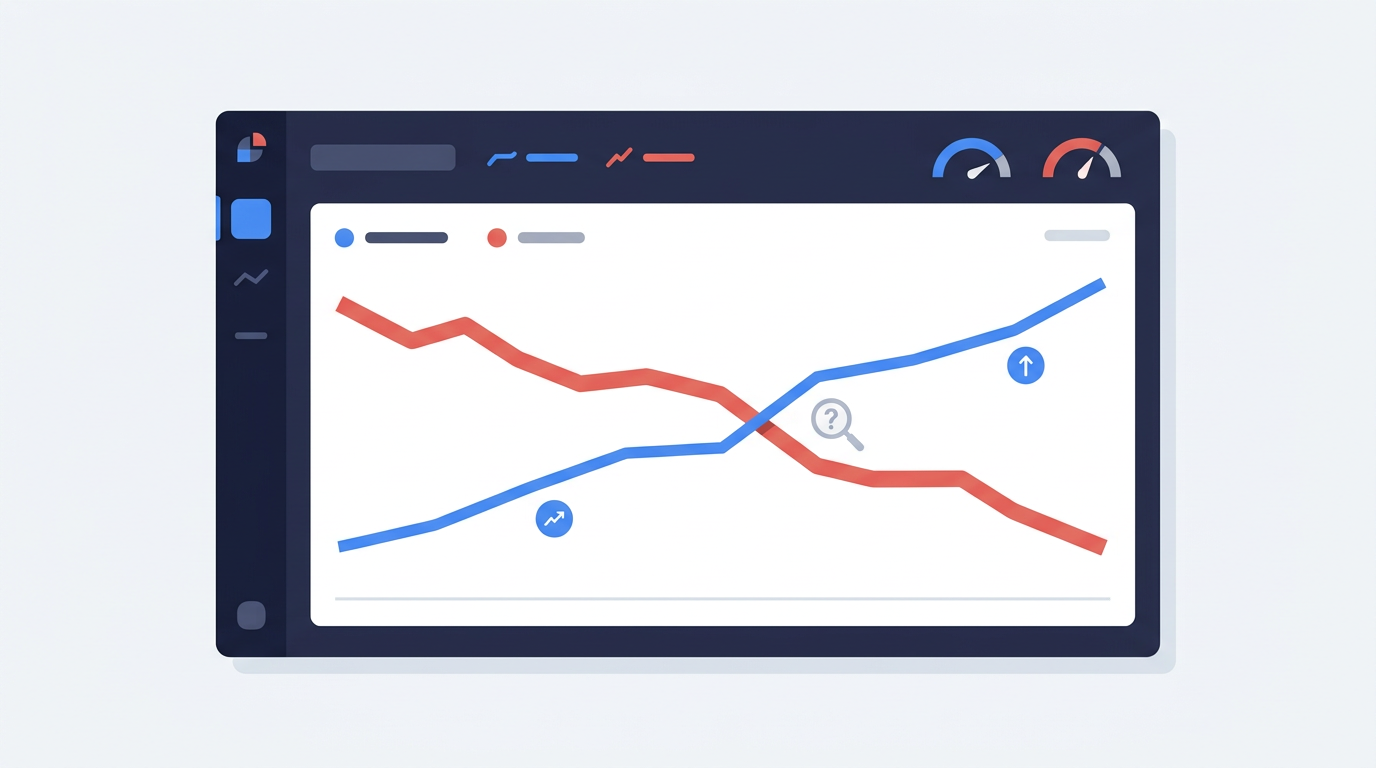
Picture this scenario: you log into your Klaviyo dashboard at the end of the month. The metrics look outstanding. Email-attributed revenue is up 35% compared to last month, and your channel accounts for nearly half of all store sales. You prepare to share the wins with leadership.
Then the executive team drops the real headline during the weekly review: total store revenue dropped by 20% across the board.
How can a channel perform so exceptionally well while the business as a whole declines? Is it still a success for the email marketer?
The honest answer is: it depends on why. Two very different things can produce the exact same dashboard, and they call for opposite responses.
- If email's gain is someone else's loss — it's re-capturing demand that would have converted anyway, just under a different label — that's a real problem, and it's one the email team should own.
- If email is holding steady or growing while a completely separate channel collapses — paid acquisition costs spiked, organic traffic dropped from an algorithm update — email isn't the cause, and calling it a failure punishes the one channel that's actually working.
The trap isn't "high email revenue while total revenue falls." The trap is not knowing which of these two situations you're in before you react.
This piece builds on the broader trust-vs-revenue principle covered in Beyond Revenue: How to Measure True Email Marketing Success — if you haven't read that one yet, it's a good starting point before diving into the mechanics below.
🎭 1. The Illusion of Success (Channel Cannibalization)
Most Email Service Providers (ESPs) use standard attribution windows — a 3-day open window or a 5-day click window, for example. If a subscriber opens an email and places an order within that window, the ESP claims 100% credit for the sale, regardless of whether that subscriber would have bought anyway.
When this is the actual cause of the gap, email isn't generating new demand — it's absorbing existing organic or direct demand in one of three common ways:
- Discounting native intent: Blasting continuous sitewide discounts or aggressive pop-ups captures shoppers who were already intent on purchasing at full price. The sale gets tagged under "Email," but profit margins shrink.
- Shift in channel attribution: Customers who would have visited directly or via organic search simply click an email link right before checking out. Total sales stay flat or drop, but the revenue gets reattributed to email.
- Aggressive list fatigue: Doubling down on send frequency spikes short-term clicks, but burns through contact health over time.
🔍 The Tell
Pull up total revenue trend and email revenue trend side by side. If email climbs at almost exactly the rate other channels decline, that's cannibalization, not incremental growth — the pie didn't get bigger, it just got resliced.
⚖️ 2. The Other Half: When Email Isn't the Problem
In practice, an email marketer usually doesn't have direct visibility into Meta CPMs or a Google algorithm update — those live in someone else's dashboard. But two numbers inside your own ESP act as a reliable proxy for the same thing:
- New subscriber growth rate. If new signups are still arriving at a normal pace, top-of-funnel traffic is likely still healthy — the list is still being fed, whatever else is happening elsewhere. A sudden drop in new subscribers is often the first visible sign, from your seat, that acquisition upstream has slowed, well before anyone hands you a CPM report.
- Unsubscribe and spam-complaint rate. If these are rising while revenue looks strong, that's the signal pointing the other way — your own program is likely the one manufacturing the number, usually through heavier discounting or more frequent batch sends. High revenue with a climbing complaint rate is not a channel doing its job well; it's a channel spending list health to protect a metric.
Put together: healthy new-subscriber growth plus rising unsubscribe/complaint rates points to cannibalization inside your own program. Declining new-subscriber growth plus stable unsubscribe/complaint rates points to an acquisition problem elsewhere that email isn't causing and can't fix. You don't need someone else's ad dashboard to tell these apart — both signals are sitting in your own ESP.
Mixing this up matters in practice: an email marketer who assumes cannibalization when the real issue is a stalled top-of-funnel will often overcorrect by discounting harder to defend their numbers — which then manufactures the real cannibalization problem out of a diagnosis that was wrong to begin with.
📅 3. One Month Isn't a Trend
Everything above is about diagnosing a single month's data. But before diagnosing anything, ask a more basic question first: is one month like this even unusual?
If November looks like this — email revenue spiking, total revenue soft, discounting heavier than usual — that's not a trap, that's BFCM. Sitewide promotions, aggressive email frequency, and a temporary dip in full-price purchasing elsewhere are the expected shape of that month, not a symptom of a broken program. Reading a single BFCM-style month as proof of cannibalization would be a misdiagnosis in the other direction.
The real question isn't "did this happen once." It's "is this becoming how the program works every month." A brand can run one heavy promo month and recover fine. What's unsustainable is a marketer who found that heavy discounting made one month look great, and then quietly keeps doing it every month afterward to keep manufacturing that same result. That's not a strategy, it's postponing a correction — and there's a limit to how many months that can be stretched before deliverability, margin, and discount dependency all catch up at once.
📈 Revenue Moves in Cycles
Revenue, like most things tied to money and markets, goes up and it goes down. A single soft month isn't automatically evidence of a failing program any more than a single strong month is proof of a thriving one. The goal isn't to force every month to look like growth — it's to tell the difference between a normal down month you can accept and a pattern of manufactured highs that's quietly borrowing against next quarter.
💥 4. The True Cost of Chasing the Wrong Fix
If the diagnosis genuinely is cannibalization and it goes unaddressed, here's how the pattern compounds over time:
A. Burnout & Deliverability Collapse
To sustain artificially high email numbers, marketers often resort to more batch-and-blast campaigns to unengaged segments. This leads directly to higher spam complaints, declining open rates, and lower domain reputation. Once major mailbox providers like Gmail or Yahoo start routing your messages to spam, your primary retention engine effectively stops working.
B. Discount Addiction & Brand Erosion
If revenue is driven primarily by constant sales, shoppers learn to never buy at full price again. The brand sacrifices its pricing power, turning full-price buyers into habitual bargain hunters.
C. Masking a Real Top-of-Funnel Problem
When channel-specific reports look green, leadership may delay diagnosing genuine acquisition issues — rising ad CPMs, declining organic SEO traffic — because the email report gave them permission to look away. This is the scenario from Section 2 turning into a real cost: a channel doing its job correctly gets used as an excuse not to fix the channel that's actually broken.
📊 5. A Balanced Metric Framework — With Context, Not Just Numbers
To tell these two scenarios apart and evaluate whether email strategy is genuinely expanding brand revenue, look at these metrics together, not in isolation:
| Metric | Focus Area | Typical Range |
|---|---|---|
| Email Share of Total Revenue | Channel contribution without over-dominating store health | Roughly 20–35% for early-stage brands; mature, high-repeat-purchase DTC brands can healthily run 35–45%+ |
| Flow-to-Campaign Ratio | Revenue from automated, high-intent behavior vs. list-wide blasts | 40–50%+ from automated flows |
| New vs. Returning Conversion | How effectively email turns first-time traffic into buyers vs. repeat purchases | Balanced split across lifecycle stages |
| Unsubscribe / Complaint Rate | Underlying list health and sender reputation | Unsubscribes < 0.2%, Complaints < 0.05% |
| New Subscriber Growth Rate | Proxy for whether top-of-funnel acquisition is still feeding the list | Steady or growing month-over-month; a sharp drop signals an upstream acquisition problem, not an email problem |
A note on the revenue-share number specifically: the "right" percentage depends heavily on repeat-purchase rate and business model. A subscription or high-LTV DTC brand can legitimately and healthily sit well above 35% — treat these as directional starting points, not a hard ceiling.
🧭 6. How a Strategic Marketer Responds
When you spot email revenue rising while overall revenue falls, the order of operations matters:
- Check the calendar before anything else. If this is BFCM, or another known heavy-promo period, this pattern is expected — don't diagnose a healthy seasonal month as a broken program.
- Diagnose using what's in your own ESP. Check new subscriber growth rate and unsubscribe/complaint rate together. Steady new-subscriber growth with rising complaints points to your own program cannibalizing itself. Declining new-subscriber growth with stable complaints points to an acquisition problem elsewhere. These two numbers, not an external ad dashboard, are the fastest read you have.
- Look at the pattern across months, not just one. One heavy-promo month that recovers is normal. The same pattern repeating every month, with no return to full-price selling, is the actual trap.
- Bring total revenue data to the discussion either way. Whether the answer is "we're cannibalizing" or "acquisition needs attention," surfacing the full picture — not just the channel win — positions you as a business partner rather than a channel coordinator defending a metric.
- If it is cannibalization: shift toward behavioral flows. Reduce batch campaign frequency and lean into hyper-targeted automated sequences — welcome, browse abandonment, post-purchase cross-sell.
- Segment discounts strategically. Reserve discount offers for unpurchased leads or churn risks. Use educational content, value props, and customer stories for engaged repeat buyers to protect margins.
🌟 The Takeaway
Email marketing is meant to build customer lifetime value and multiply business growth — not mask a shrinking customer base, and not take the blame for a shrinking customer base it didn't cause either. Real success isn't just winning attribution on one channel's dashboard; it's knowing which channel actually needs the fix, and being honest about which one it is.